

A peer is someone who shares similar interests with you, be they leisure or professional, and your conversations with peers tend to have more depth compared to those with non-peers.
These sorts of conversations are what make face-to-face corporate events so compelling, and the ideas and insights that people bring up organically during these conversations are worth their weight in gold to marketers and entrepreneurs alike.
From our experience supporting community events for clients like StaffAny, we’ve seen discussions from attendees that reveal the true pain points their target audience is facing, the topics they’d like to hear more of and the different activities our client uses for different contexts.
These insights give us context that can be difficult to learn from secondary sources or marketing dashboards. These valuable insights and the relationships that participants can build with one another will keep participants coming back for your next event.
Enabling these natural conversations in your events takes some thought about how you bring people together and what you can do once they start talking.
Give People Room to Share Their Experience
If you’re hosting your brand’s very first event, you won’t have any participant feedback to work with yet, so researching themes and pain points such as interviewing industry peers or checking online and offline discussions is a must.
If your event goes well and participants engage your team during the questions and answers session, you’ll start striking gold. Commonly recurring questions give us an indication of what people really care about, or what they want to hear more of if they weren’t satisfied with the existing answers. What starts as a broad and safe topic leads to valuable insight for narrower, more specific, and more importantly highly valued topics for future events.
For example, a topic about upgrading your business’s technology led to a new event discussing how these companies apply AI within their businesses. Another event that discussed cost management more broadly led to future events discussing the challenges and constraints of hiring in the F&B space.
When people are engaged with the topic and the discussion, valuable details can be found among their questions and comments. Their input then helps us understand the thoughts, needs, and circumstances behind a business decision or problem they are facing.
If the event features a fireside chat or panel discussions, hosts can encourage more depth through questions such as: What have you already tried? Where did you run into difficulties? What would make this easier to put into practice? These questions can also be asked to the audience in the form of yes or no questions that can be answered by raising one’s hand.
Whichever way you choose to do it, one of your goals during these community events is to give people room to explain their experience, while allowing others to contribute their own.
Trust Works Differently When Customers and Prospects Meet
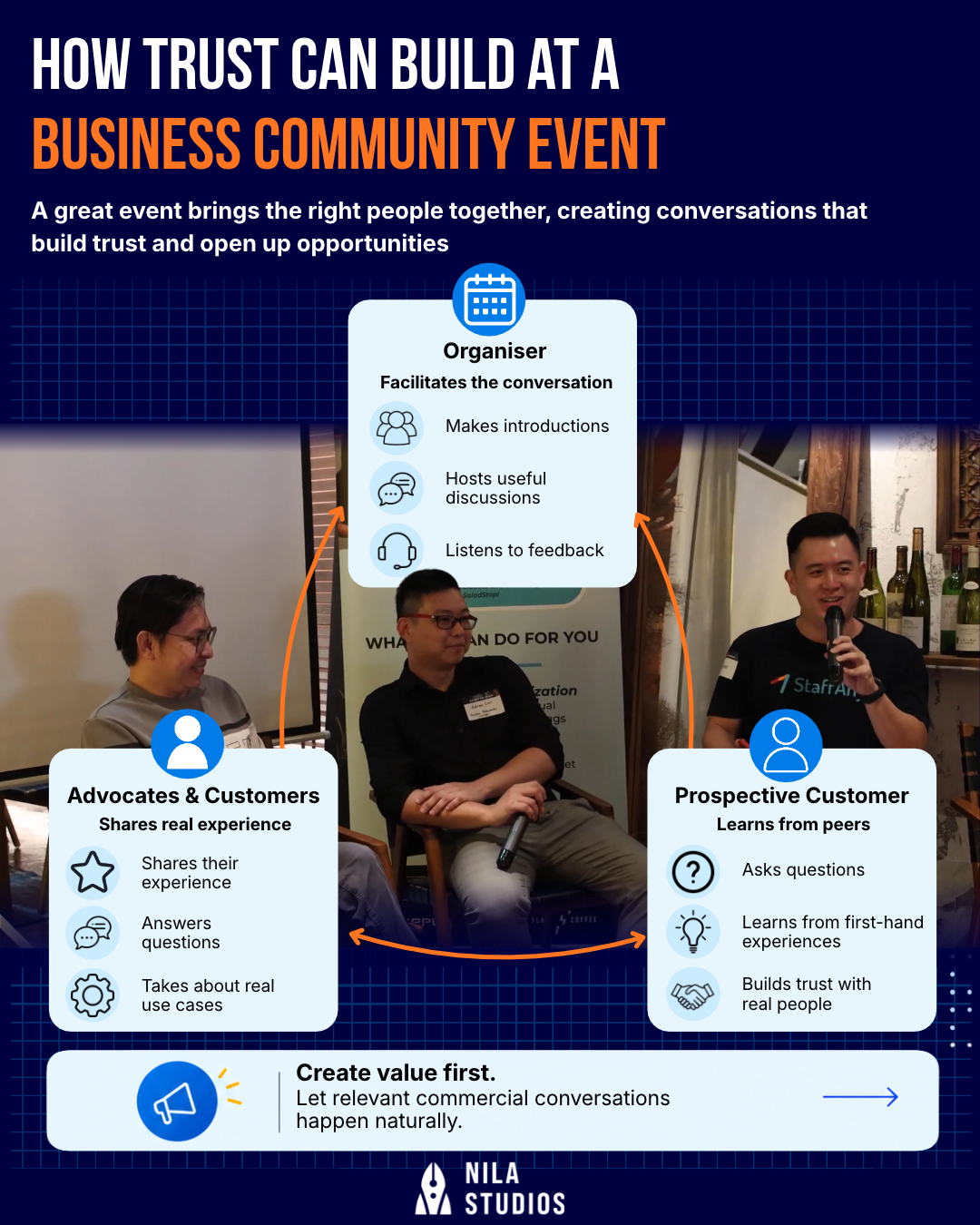
Sometimes, when your customers are very pleased with your product and service experience, they will turn into brand ambassadors who are willing to share your brand with others. These brand ambassadors can become even more effective when given opportunities to strut their stuff during organic conversations with your prospects.
While working with our client, we frequently see their brand ambassadors mingle with prospective customers and naturally advocate their brand, all without prompting. When your customer is already a genuine advocate, they can answer questions your prospects have from their own experience.
Meanwhile, the upper management can also use this opportunity to collect valuable feedback from existing customers to refine the product. Speaking with them face-to-face also makes them feel heard and valued, strengthening client relationships. There’s an old adage:
“People won’t always remember how you helped them, but they’ll remember how you made them feel.”
The most important thing we’ve seen through all this is to keep things natural and avoid pressuring people. By creating value first and allowing relevant commercial conversations to develop when there is a reason for them to, it keeps people coming back.
Hosting and Staff Preparation
Another surprising learning we took away is that we’ve seen that organising brands benefit from exercising restraint. To encourage attendees to engage with the staff, staff should avoid direct sales pitches. Instead, they can act as helpful facilitators who can help participants network with one another and form useful connections.
Facilitators who are familiar with repeat attendees can link them up with newer guests who may have shared interests. These facilitators can also be armed with icebreakers, questions related to the theme or main discussion that the speaker was sharing about, or simply just listen to feedback on the event or the business itself.
Preparing the team beforehand gives that role more shape. Who will welcome attendees? Who can help with introductions? What questions could open a useful discussion? How should staff respond when someone raises a product concern?
At Nila Studios, we can help with programme planning, hosting and staff preparation so the team has a clear idea of how to support the gathering. A good programme gives the discussion direction while leaving space for participants to bring their own questions.
Turn What You Hear into Questions Worth Exploring
Just as frequent comments and questions during the Q&A sessions can turn into more specific discussions over time, each event gives us a chance to review what we’ve learned and put it into compounding value for future events.
During these reviews, we can ask:
- What questions appeared repeatedly?
- Which assumptions were challenged?
- Did different types of businesses describe the same problem differently?
- What did participants want to understand next?
But we also need to be careful to verify what we hear from the audience. Lone comments may be interesting without representing the wider market, or they could be the lone voice of a silent majority. Recurring themes among attendee feedback also require further verification before we turn it into the basis for a major decision. Basically, it’s good practice to verify what we’ve learned without assuming that everything that was shared is automatically true.
To verify these, we can compare those observations with customer interviews, existing research and other feedback. Together, they give us a stronger starting point for deciding what to test.
Give The Learning Somewhere to Go
Turning every event into a learning opportunity segues nicely to our conclusion. When we listen well to participant feedback and carefully verify and analyse what they have to say, we earn dividends in terms of valuable learning. We could get a niche topic that leads to a popular future event, and even candid feedback about how our brand and services are doing can lead to the next business breakthrough.
This is also where marketing advisory can help. At Nila, we work with founders and teams to interpret what they are hearing, identify assumptions and choose what to explore next. These events don’t need to answer every question. Their value can begin with helping us ask better questions.
When participants leave with useful connections and the organising team leaves with a clearer understanding of its audience, there is something worth building on at the next gathering.
About Nila Studios
Bringing together B2B marketing expertise, business operations experience, and creative production, Nila Studios helps businesses tell their stories to their ideal customers. We support community events through audience and programme planning, event promotion, hosting and facilitation, and content production that keeps useful ideas moving beyond the room.
Planning a community event or looking to get more from the ones you already run? Talk to us about bringing your events and wider marketing efforts together.
